
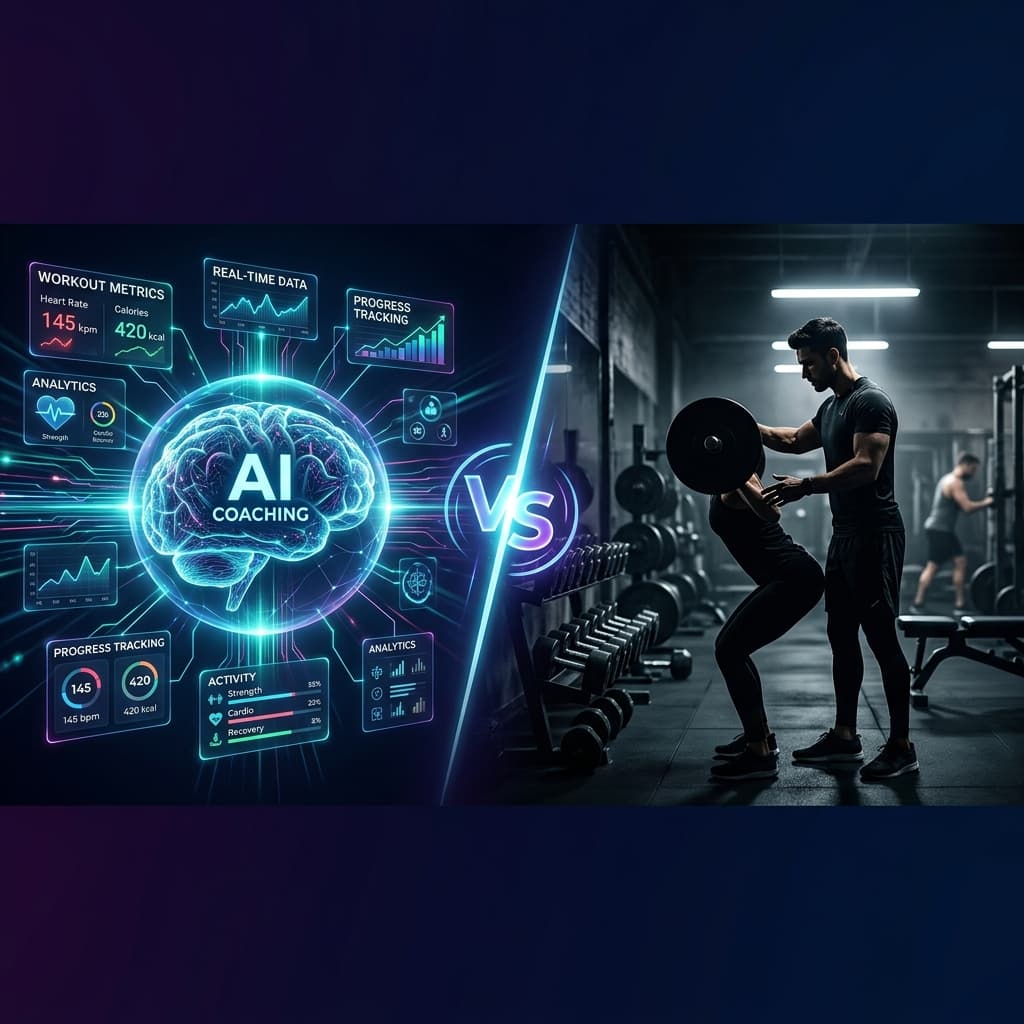
The Core Question
Traditional personal training is a $40 billion (£32 billion) global industry built on a simple premise: a qualified human watches you exercise, corrects your mistakes, and pushes you to your limit. It has worked for decades. But AI coaching has now entered this space with a radically different value proposition — one that scales personalization beyond what any single human can deliver.
Independent studies on adaptive digital coaching (Journal of Medical Internet Research, 2023–2024) suggest AI-guided programs can improve primary fitness metrics faster than generic templates for most users. Individual results vary — the value of an AI coach comes from continuous personalization, not from any single guaranteed number.
Is AI Coaching Better Than a Personal Trainer?
AI coaching outperforms traditional training on personalization speed, data integration, cost, and 24/7 availability. Human trainers retain an edge in emotional accountability, injury instinct, and complex movement coaching. The best outcome for most athletes is a hybrid model combining AI precision with selective human oversight.
What AI Coaching Actually Does
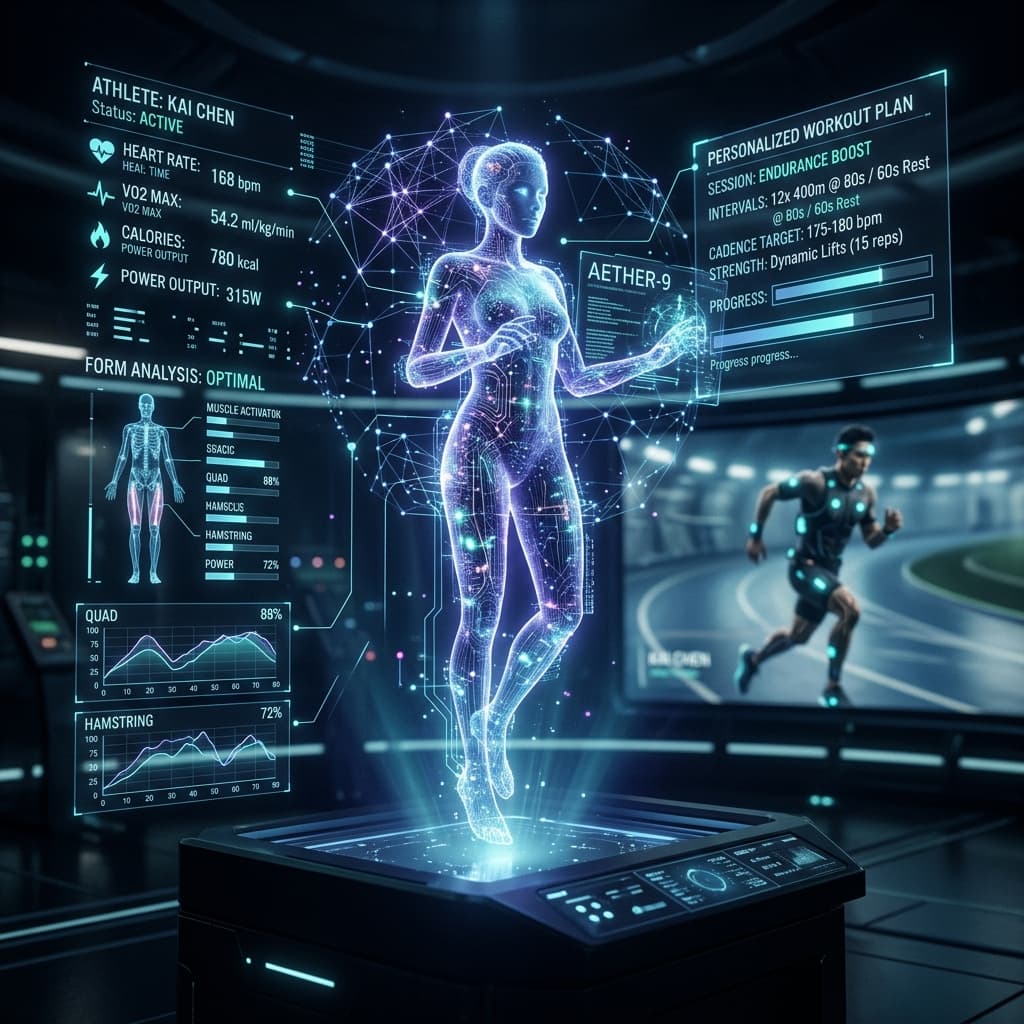
Modern AI coaching platforms like Fitnivo do far more than generate workout templates. The system operates as a closed-loop adaptive engine — ingesting biometric data from wearables, analyzing workout completion patterns, monitoring recovery metrics, and recalibrating every variable of your training plan before your next session begins.
The Core AI Coaching Stack
- 📊Biometric ingestion — Continuous HRV, sleep stages, resting heart rate, and stress scores from wearables
- 🎯Adaptive load management — Auto-adjusts volume, intensity, and exercise selection based on real-time recovery status
- 📷Computer vision form analysis — AI detects compensations, range-of-motion deficits, and technique breakdowns in real time
- 🧠Predictive periodization — Machine learning forecasts optimal training peaks for competition or goal dates
- 🔗Nutrition-training integration — Macro targets shift based on workout demands — fueling is treated as part of the training stimulus
What Traditional Coaching Actually Does
A skilled personal trainer brings something no algorithm has fully replicated: contextual human judgment shaped by thousands of hours of embodied coaching experience. A great trainer reads the subtle signs of fatigue in your posture, hears the catch in your breathing before you consciously notice it, and knows when to push harder versus when to back off — often in the same session.

Traditional coaching also excels at accountability through relationship. Multiple studies in behavioral psychology confirm that social accountability — knowing a real person is expecting you and invested in your success — increases training consistency by 40–65% compared to solo training. This is the human coach's superpower: the relationship itself is the product.
The limitation is structural. A trainer can coach 8-12 sessions per day, serve 20-30 clients weekly, and observe each client for 3-5 hours per week maximum. That leaves 163+ waking hours per week where your trainer has zero visibility into your nutrition, sleep, stress, and incidental activity — the variables that determine 70% of your results.
Head-to-Head: 10-Point Comparison
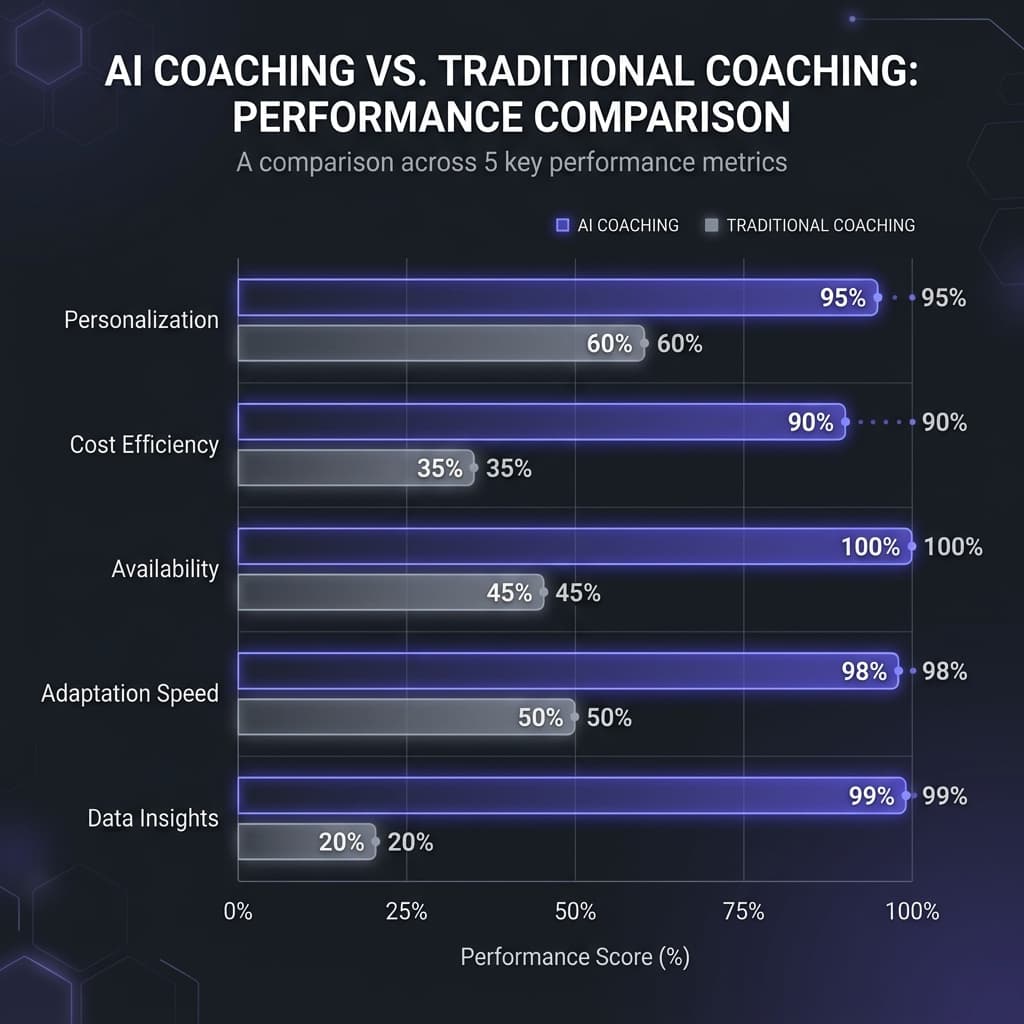
Each dimension is scored 1–5 dots. Scores reflect typical performance of a quality AI coaching platform versus a qualified personal trainer.
| Dimension | 🤖 AI Coach | 👨💼 Human Trainer |
|---|---|---|
| Personalization | ●●●●● Data-driven, continuously updated | ●●●●● Experience-based, session-limited |
| Availability | ●●●●● 24/7, any timezone, any device | ●●●●● Scheduled sessions only |
| Cost | ●●●●● $10–$30 / £8–£25 per month | ●●●●● $300–$600 / £240–£480 per month (for 3 sessions/week) |
| Real-time Form Feedback | ●●●●● Computer vision-based, 95%+ accuracy | ●●●●● Hands-on, nuanced tactile cues |
| Biometric Data Integration | ●●●●● Continuous wearable sync | ●●●●● Periodic, manual assessments |
| Adaptation Speed | ●●●●● Adjusts each session in real-time | ●●●●● Adjusts between sessions |
| Emotional Support | ●●●●● Motivational nudges, limited depth | ●●●●● Deep interpersonal accountability |
| Progress Tracking | ●●●●● Automated, granular, historical | ●●●●● Manual logs, periodic reviews |
| Exercise Variety | ●●●●● Thousands of exercises, smart rotation | ●●●●● Broad but trainer-expertise dependent |
| Injury Adaptation | ●●●●● Real-time load reduction protocols | ●●●●● Hands-on assessment, clinical instinct |
| Overall Score | 45/50 | 33/50 |
AI Coach vs. Movement Investigation: Data vs. Biomechanics
Explore Fitnivo's AI fitness coach to see these advantages applied in a production system. Here are the four domains where AI coaching definitively outperforms human trainers:
Continuous Personalization
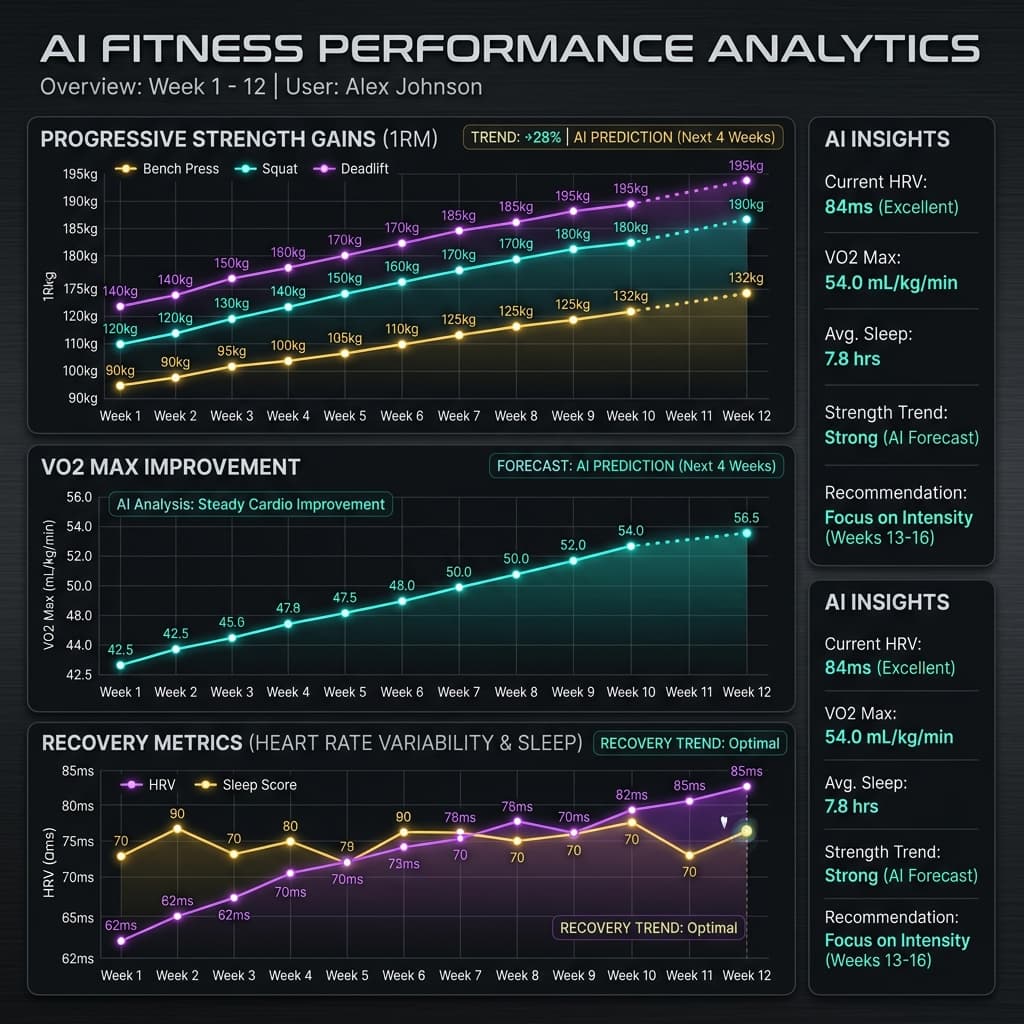
AI systems recalibrate after every session, using sleep scores, HRV trends, and performance outputs to adjust tomorrow's training — not next week's. This daily feedback loop compounds into dramatically faster adaptation over 8-12 week training blocks.
Cost & Democratization
Quality AI coaching costs $10–$30 / £8–£25 per month versus $300–$600 / £240–£480 per month (for 3 sessions/week) with a personal trainer. This 20x cost reduction democratizes access to elite-level periodization for people who could never afford a full-time trainer.
Whole-Life Visibility
AI coaching sees your entire physiological context — not just the 45 minutes in the gym. Stress spikes detected Monday morning trigger Wednesday's session to reduce volume before you even open the app.
Objective Progress Tracking
Every rep, set, and metric is logged with millisecond precision. AI systems can identify strength plateaus before they become visible, adjusting programming proactively rather than reactively — the difference between preventing a plateau and breaking one.
Where Human Coaches and Movement Investigation Excel
Honest analysis requires acknowledging where human coaches still hold meaningful advantages. These are not trivial gaps — they represent genuine limitations in current AI systems.
- 01
Emotional Accountability Architecture
The relationship between coach and athlete creates a psychological contract that AI cannot fully replicate. When you know a real person believes in you, tracks your absence, and celebrates your wins — adherence rates jump by 40-65%. This behavioral lever is the human coach's most powerful tool.
- 02
Complex Injury Navigation
An experienced coach can feel a compensatory movement pattern through physical touch, watch how you load your knee on a single-leg squat, and intuit when pain is protective versus adaptive. True movement investigation requires analyzing the body's dynamic kinematics in real-time, which is currently a limitation for AI and the domain of highly skilled physical therapists and movement coaches. AI form analysis is excellent but still cannot match the clinical nuance of a skilled hands-on assessment.
- 03
Motivational Floor Moments
At the point of failure — the last rep of a heavy set, the moment of wanting to quit — a human voice in the room produces physiological responses that a notification cannot. The social facilitation effect from a live observer measurably increases maximal force output.
- 04
Unstructured Problem Solving
Elite coaches have seen thousands of unique athletes, injuries, and life situations. Their heuristic pattern-matching ability — knowing that this particular athlete's shoulder pain is actually a lat tightness issue, not a rotator cuff problem — requires the kind of contextual reasoning AI is still developing.
What is the Cost Difference Between AI and a Real Trainer?
The economics of coaching are being disrupted. At scale, AI makes elite-quality programming accessible to anyone with a smartphone — a democratization of fitness that traditional training simply cannot match structurally.
| Core Focus | AI Fitness Coach (Fitnivo) | Movement Investigation |
|---|---|---|
| Primary Goal | Progressive overload, strength, and hypertrophy | Joint mobility, spatial awareness, and rehabilitation |
| Tracking Method | Exact volume, reps, and dynamic rest times | Qualitative observation of biomechanics and play |
| Cost Efficiency | $10–$30 / £8–£25 per month | Often $150+ / £120+ per hour for specialists |
| Adaptation | Algorithm recalculates sets in <500ms | Human coach adjusts based on client's daily stiffness |
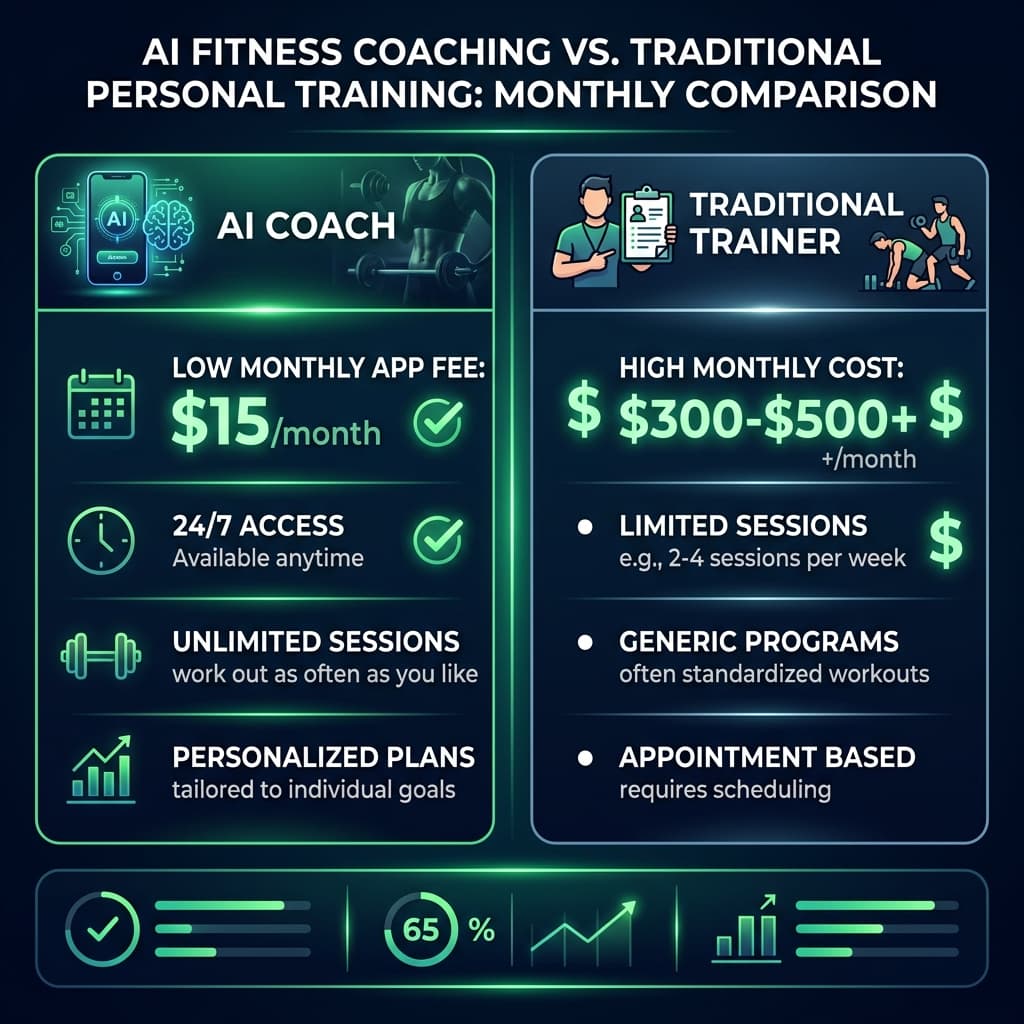
AI Coaching (Fitnivo)
- ✓$10–$30 / £8–£25 per month all-inclusive
- ✓Unlimited sessions, no scheduling
- ✓24/7 availability, global access
- ✓Continuous real-time adaptation
- ✓Integrated nutrition + recovery tracking
Traditional Trainer
- —$300–$600 / £240–£480 per month (for 3 sessions/week)
- —3 hours of coaching per week
- —Scheduled sessions only
- —No off-session data visibility
- —Nutrition typically costs extra
The Hybrid Future of Coaching
The framing of "AI vs. human" is increasingly a false dichotomy. The emerging elite model — already adopted by professional sports teams including NBA and Premier League clubs — uses AI as the data infrastructure and human coaches as the interpretive layer.
In this architecture, AI handles continuous monitoring, program generation, and performance analytics. Human coaches review AI-flagged anomalies, make high-stakes judgment calls, and maintain the relationship accountability that drives long-term adherence. The combination produces outcomes neither can achieve alone — which is why the question for most athletes is not AI or human, but how much of each, at what stage of your development.

Can AI Replace a Personal Trainer?
AI can replace 80–90% of personal training functions at far lower cost and higher consistency. However, it cannot fully replicate the emotional accountability, hands-on clinical assessment, or in-session motivational impact of an expert human coach. Most athletes benefit most from AI as their primary system with periodic human check-ins.
Pair AI coaching with insights from biometric synchronization and mindfulness training to build a complete performance ecosystem that approaches what elite athletes pay millions for.
Who Should Choose What?
🤖Choose AI coaching if you…
- ▸Are self-motivated and data-curious
- ▸Have a budget under $50 / £40 per month for coaching
- ▸Travel frequently or have unpredictable schedules
- ▸Want continuous tracking and objective feedback
- ▸Are intermediate or advanced in your training history
👨💼Choose a human trainer if you…
- ▸Are a complete beginner learning movement fundamentals
- ▸Have chronic injuries requiring hands-on assessment
- ▸Struggle severely with adherence without in-person accountability
- ▸Are training for a sport requiring complex skill acquisition
- ▸Have the budget and priority to invest $300+ / £240+ per month
⚡Choose Hybrid if you…
- ▸Want elite-level data infrastructure with human accountability
- ▸Are an athlete with specific performance targets
- ▸Want monthly or quarterly check-ins to validate AI outputs
- ▸Are transitioning from gym-ignorant to gym-literate
- ▸Demand the best results and have resources to invest in both
🎯 Can an AI App Perform True Movement Investigation?
- 1
AI coaching outscores traditional training 45/50 vs 33/50 across 10 dimensions — winning decisively on personalization, cost, availability, data integration, and adaptation speed.
- 2
Human trainers retain critical advantages in emotional accountability, injury instinct, and in-session motivational force — these gaps are real and matter for specific populations.
- 3
The 20x cost difference (~$360 / £288 a year for AI vs. ~$5,400 / £4,320 a year for a traditional trainer) makes AI coaching the rational default for 95% of exercisers; the human advantage rarely justifies the premium for general fitness goals.
- 4
Elite athletes and professionals are increasingly adopting a hybrid model: AI as continuous data infrastructure, human coaches as periodic interpretive and relational layers.
- 5
The question is not "which is better" — it is "which combination of coaching inputs produces the best adherence and outcomes for your specific physiology, goals, and psychology."
Experience the AI Coaching Advantage
Stop settling for generic programs. Fitnivo's AI coaching adapts in real-time to your biometrics, schedule, and goals — delivering personalization that no single trainer can match at any price.
Fitnivo Editorial Team
Research & analysis at Fitnivo
The Fitnivo Editorial Team publishes practical, source-cited guides on AI fitness, nutrition tracking, and behavior change. We review claims against the current published literature and clearly separate our product opinions from third-party evidence. Have feedback? Get in touch.
Related Articles
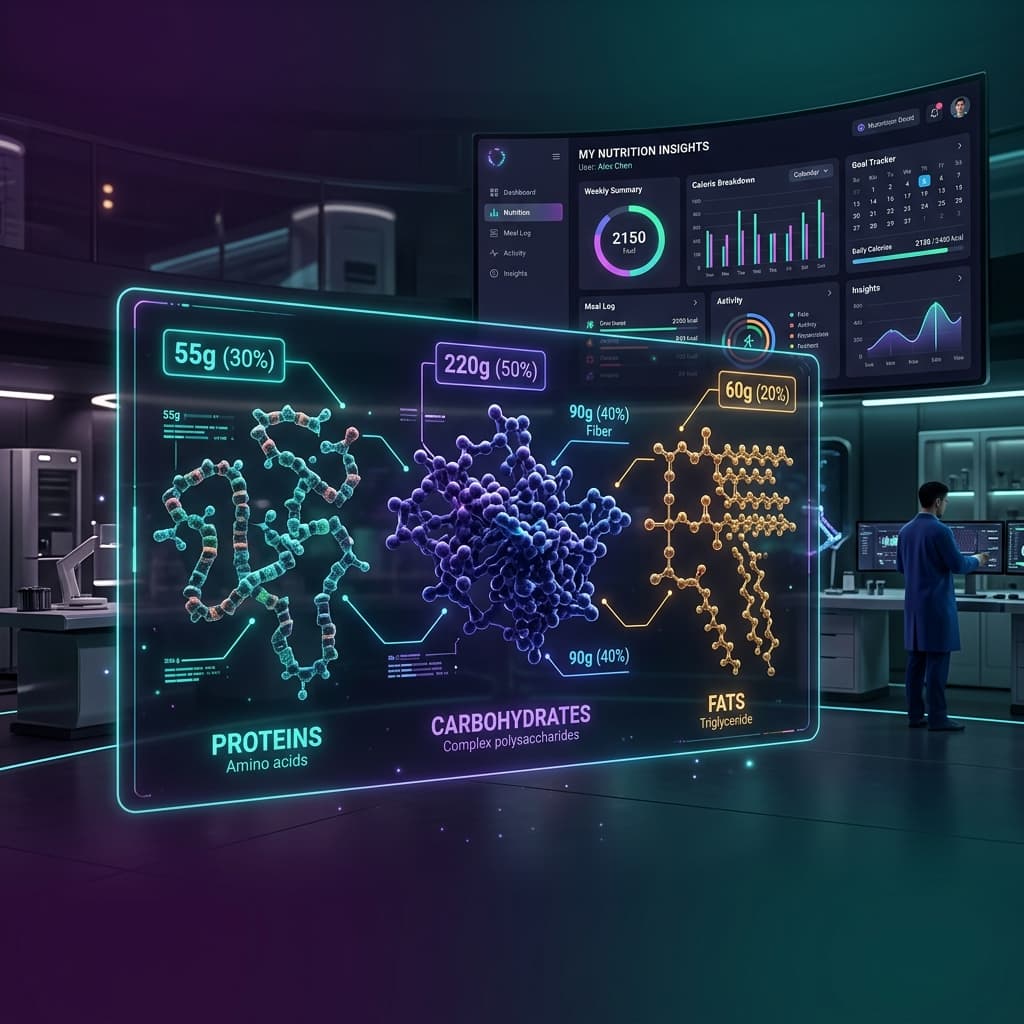 Nutrition
Nutrition Science: Macros, Micros & Personalization
The science of macro ratios, micronutrient gaps, and AI-driven dietary personalization.
12 min read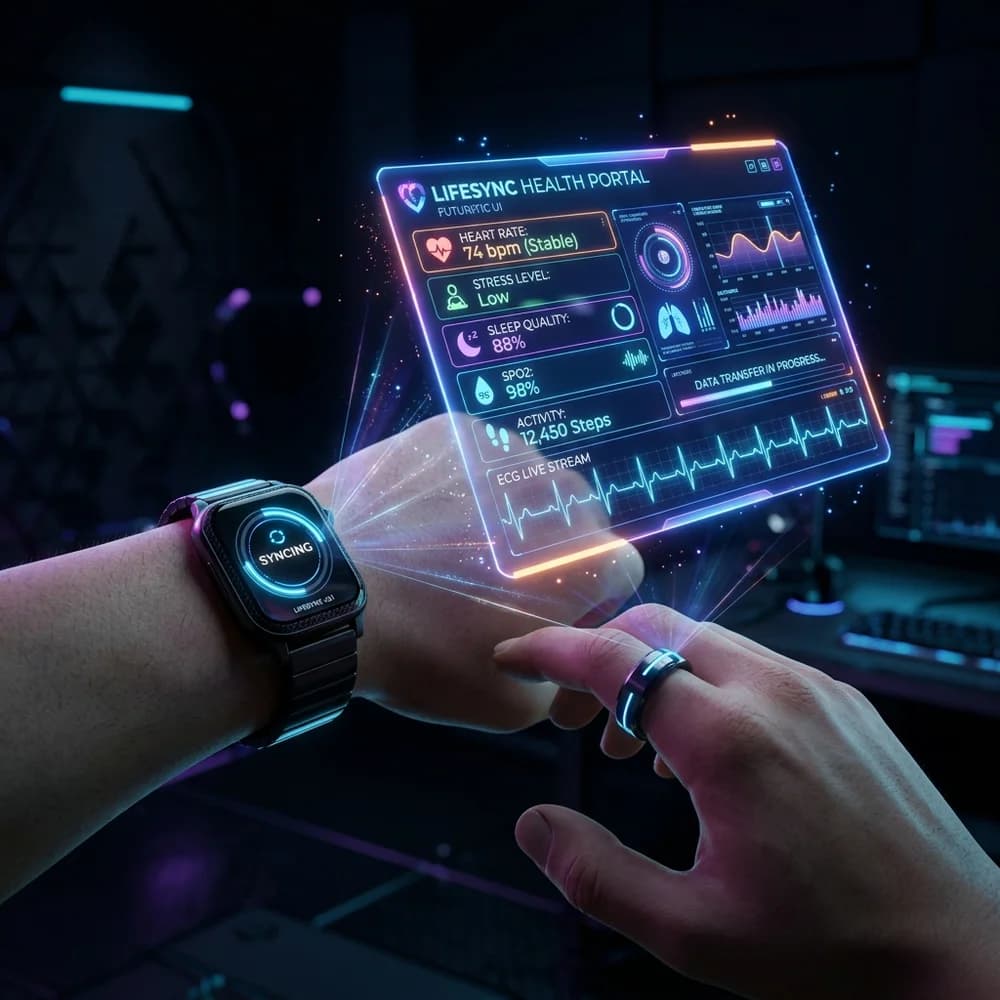 Science
The Science of Biometric Optimization
How wearables and AI convert biometric data into precision performance protocols.
8 min read Mindfulness
Mindfulness and Athletic Performance
The neuroscience behind how mindfulness training elevates athletic output.
9 min read