

Willpower is finite. We wake up with a full reservoir, but throughout the day, decision fatigue, stress, and physical fatigue slowly drain it. By the time the evening rolls around, asking your brain to overcome workout resistance using sheer motivation is a losing battle.
Behavioral science fitness approaches the problem from a completely different angle. Instead of forcing behavior through sheer mental pressure, we design environments and build neurological habits that require minimal conscious effort. When a habit becomes automatic, it bypasses the parts of your brain responsible for decision fatigue entirely.
In this deep dive, we will outline the neuroscience of habit formation, explain the exact mechanisms behind Duhigg's habit loop, and give you actionable tools to make exercise as natural and automatic as brushing your teeth.
The Behavioral Science of Exercise: Why Willpower Fails
To understand why willpower fails, we must look at the structural division of the brain. Conscious decisions, planning, and self-control are managed by the prefrontal cortex. This is the executive center of the brain. It is highly advanced but consumes massive amounts of energy and tires easily.
In contrast, automatic habits are stored in the basal ganglia. This is a much older, primitive part of the brain designed to conserve energy. When the brain detects a repeating behavioral loop, it shifts the activity from the prefrontal cortex to the basal ganglia, turning it into a chunked, automatic script.
Research shows that the brain operates on autopilot for roughly 45% of our daily actions to save energy. When you are forced to consciously decide whether or not to work out, you are burning prefrontal cortex energy. The goal of behavioral fitness is to move the workout out of the prefrontal cortex and into the basal ganglia, making it a permanent neural pathway.
This transition requires neuroplasticity—the brain's physical ability to restructure its neural pathways through repetition. By consistently reinforcing a specific habit loop, you physically build neural pathways that make workout resistance vanish.
The 3-Step Habit Loop for Fitness
The primary framework of behavioral habit change is the Habit Loop, popularized by Charles Duhigg. It consists of three distinct phases: the Cue, the Routine, and the Reward. If any of these three stages are weak or missing, the habit loop collapses and the behavior fails to become automatic.
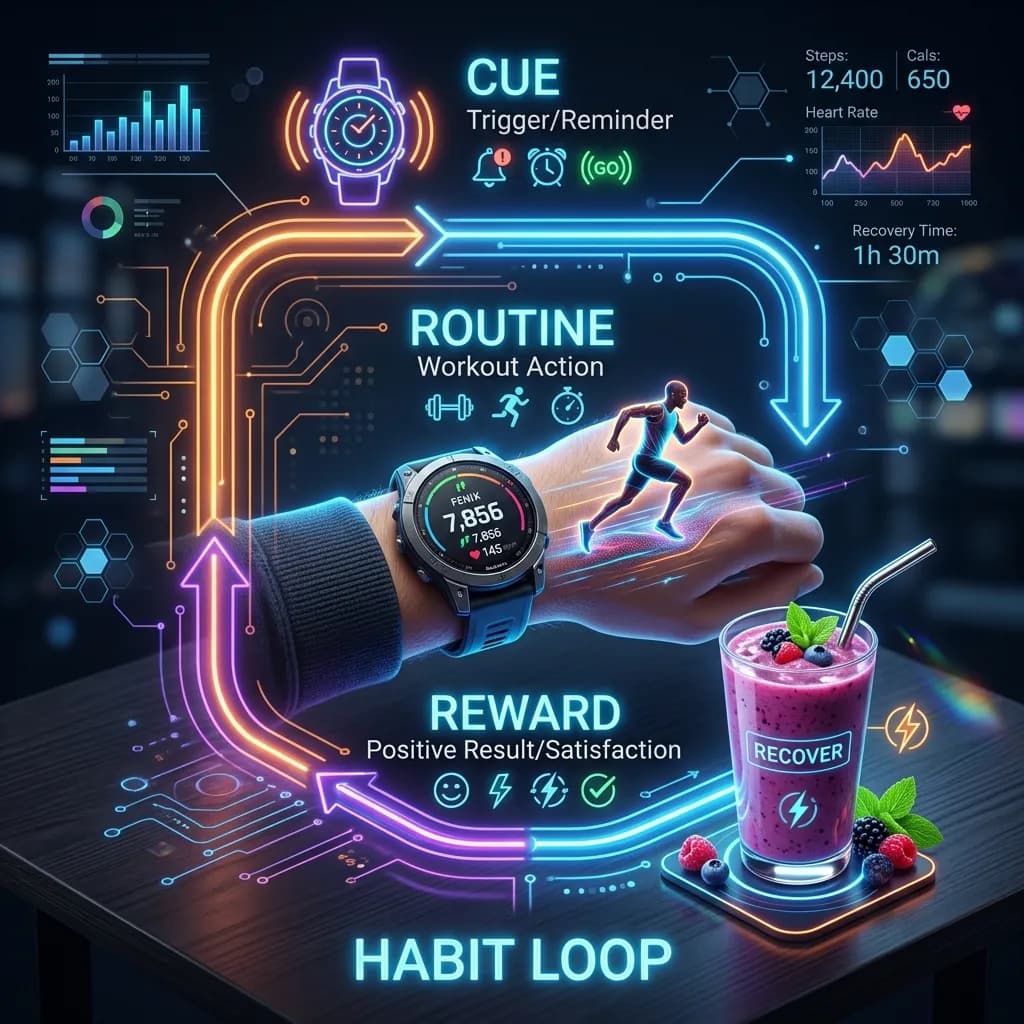
1. The Cue (Trigger)
A cue is the anchor that launches the automatic routine. Vague intentions like "I will work out today" fail because they lack a defined sensory trigger. A strong cue is always specific, immediate, and tied directly to your existing schedule or location.
- Time-based cues: "Every day at exactly 6:00 PM, I will walk out the front door."
- Preceding action cues: "When I close my laptop at the end of the workday, I immediately change into my athletic shirt."
- Location-based cues: "The second I pass the local community gym on my commute home, I pull into the parking lot."
2. The Routine (Action)
The routine is the behavior you want to automate. The most common mistake beginners make is designing routines that are physically exhausting or take too long to complete. When starting, focus entirely on consistency rather than intensity.
- Scale it down: A 10-minute bodyweight circuit at home preserves the habit loop just as well as a 90-minute heavy weightlifting session.
- Focus on show-up rate: In the first month, your primary goal is to build the automatic trigger-action association.
- Avoid burnout: Do not push to absolute failure or physical exhaustion in the first few weeks, as this associates the routine with pain.
3. The Reward (Reinforcement)
The reward is the positive reinforcement that tells your brain the loop is worth remembering. Long-term rewards like fat loss, cardiovascular health, or muscle hypertrophy take weeks or months to manifest. The primitive basal ganglia cannot wait that long; it requires an immediate reward to cement the loop.
- Intrinsic Motivation: Celebrate the immediate post-workout endorphin rush or the feeling of stress melting away.
- Extrinsic Rewards: Enjoy a specific protein smoothie, watch a favorite show only while on the treadmill, or check off your visual habit streak.
- Loss-Aversion: Track your consistency scores. The pain of breaking a streak can act as a powerful behavioral driver.
How Long Does It Actually Take to Build an Exercise Habit?
We have all heard the popular myth that it takes exactly 21 days to form a new habit. This widely cited statistic actually originated from a misinterpretation of a plastic surgeon's observations about patients adjusting to amputations.
The actual scientific data paints a different picture. In a landmark study led by Dr. Phillippa Lally at University College London, researchers tracked habit formation over several months.
The study proved that it takes an average of **66 days** for a new behavior to reach peak automaticity. For complex behaviors like exercise, the timeline can range from 18 days to as long as 254 days depending on environmental triggers and complexity. Setting a realistic 2-to-3 month expectation prevents you from quitting early when the behavior still feels like a conscious effort.
3 Behavioral Hacks to Automate Your Workout
Beyond the basic habit loop, there are advanced behavioral hacks derived from clinical psychology that you can use to optimize your routine immediately.

1. Habit Stacking
Habit stacking, popularized by James Clear, is the process of linking a new habit to an existing daily anchor. Rather than trying to build a habit out of thin air, you overlay it on top of a behavior you already perform automatically.
- The formula: "After [Current Habit], I will [New Habit]."
- Example 1: "After I brush my teeth in the morning, I will immediately perform 15 squats."
- Example 2: "After I pour my morning coffee, I will open my Fitnivo app and view today's workout targets."
2. Environmental Friction Reduction
Your physical environment is the ultimate architect of your behavior. Friction reduction is the practice of making good habits incredibly easy to start, while making bad habits difficult.
- Prep the night before: Pack your gym bag, lay out your lifting straps, and place your running shoes directly beside the bed.
- Eliminate choices: Choose your workout clothes and write your exercise schedule on Sunday to eliminate decision fatigue during the week.
- Create resistance for distractions: Put the television remote in another room or log out of social media apps before your workout window.
3. The Two-Minute Rule
The Two-Minute Rule states that any new habit should take less than two minutes to start. If you are feeling massive resistance to a workout, give yourself permission to exercise for just two minutes.
- Show up: Put on your gym clothes, drive to the gym, and stretch for two minutes.
- Momentum build: In 90% of cases, once you overcome the initial starting friction, momentum takes over and you complete the session.
- Preserve the loop: Even if you leave after two minutes, you successfully triggered the cue and routine, keeping the neural loop alive.
How Fitnivo Uses Behavioral Science
The Fitnivo app is structurally built on these exact behavioral principles. It acts as an external nervous system, offloading the cognitive planning that often halts progress.
First, Fitnivo delivers clear, time-based cues through automated notifications. Second, it reduces environmental friction by using a personal AI trainer to generate your exact workout based on the equipment you have available, eliminating gym decision fatigue.
Finally, it provides immediate reward loops through progress streaks, set-velocity checks, and macro-sync notifications, closing the neural loop and helping you reach the 66-day automaticity threshold.
Frequently Asked Questions
What if I miss a workout day?
Missing one day does not reset the habit loop. The behavioral goal is simply to never miss two days in a row. Focus on getting right back on track during the next scheduled window.
Why is it so hard to stay motivated to exercise?
Motivation is an emotion, which is inherently unstable. Sustainable exercise relies on environmental cues and structured routines rather than fleeting spikes of motivation.
Does habit stacking work for fitness?
Yes, linking a short exercise routine to an already established daily habit is one of the fastest ways to build neural pathways for fitness. It leverages existing automated behaviors to build new ones.